
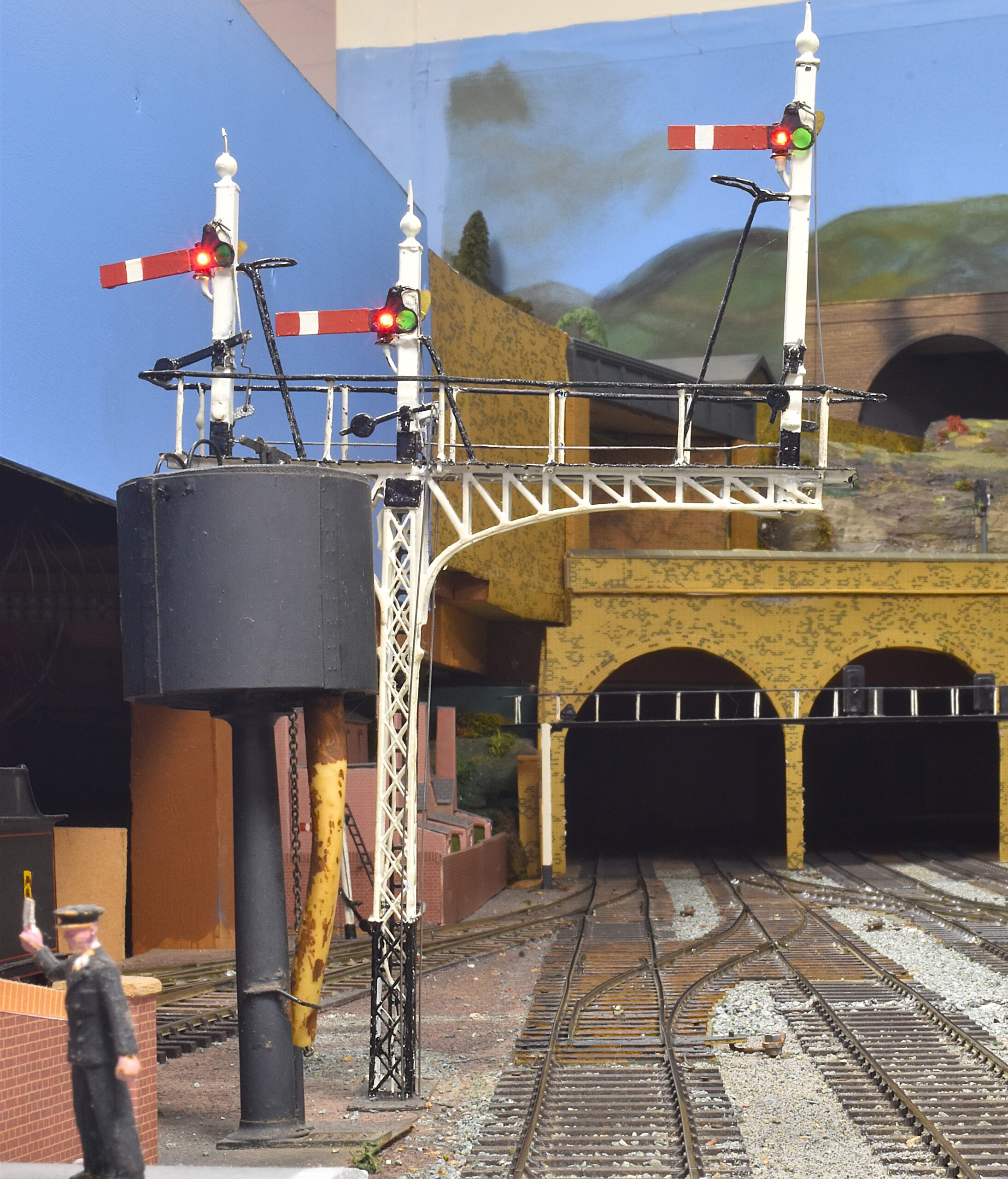
Signals are an essential safety feature on the real railway and so their operation is replicated on our railway. Signals tell the driver of a train whether or not it is safe to proceed and can also indicate the route a train is to take. Our control panels are fully equipped to resemble a real-life signal box, with block bells and block indicators, telephones, and switches that either resemble an IFS panel, or the levers in a mechanical signal box, this can then enable us to run our trains to the Absolute Block Signalling System which is still used in real life on parts of the network today.
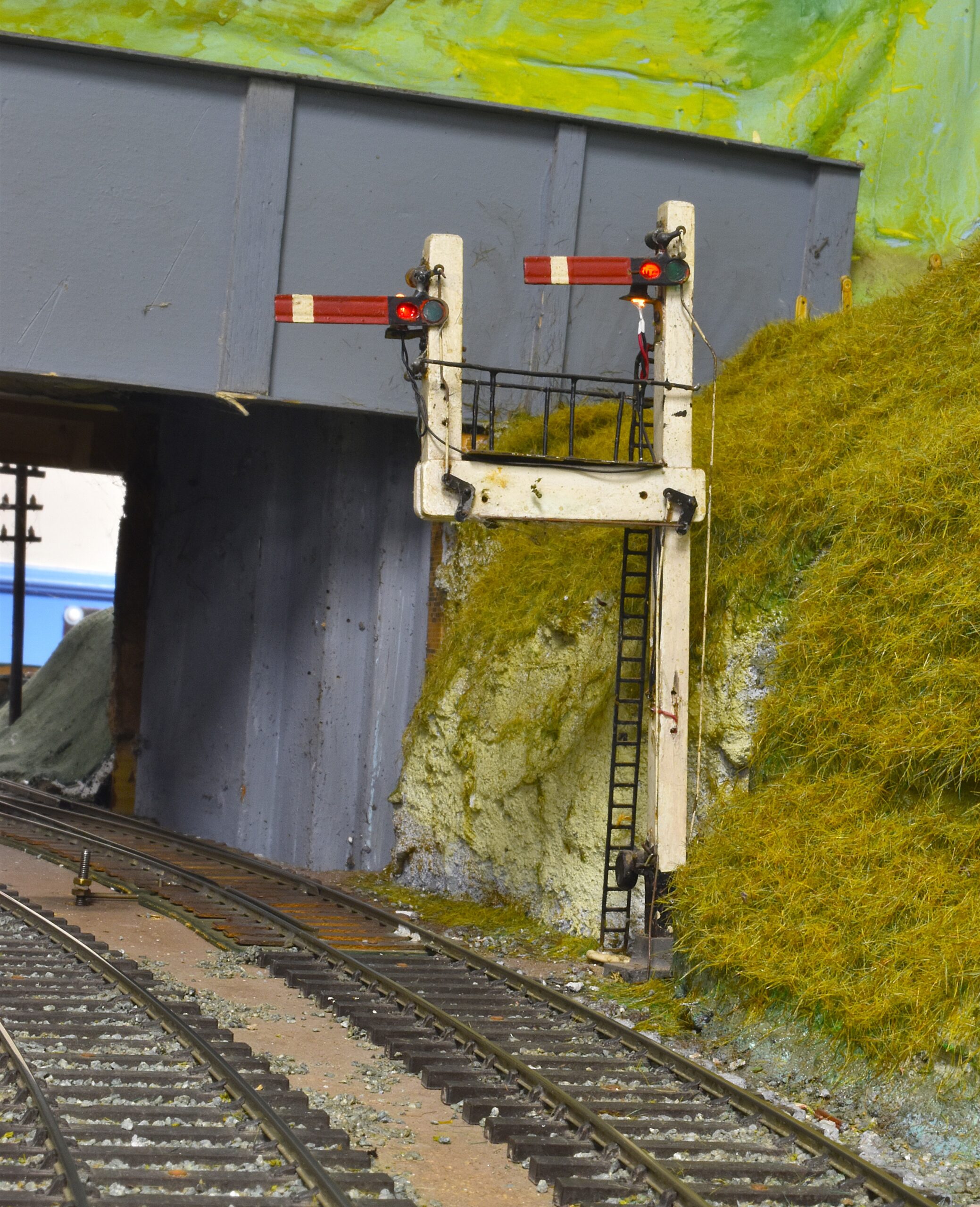
There are two main types of signal on the railway – semaphore signals and colour light signals.
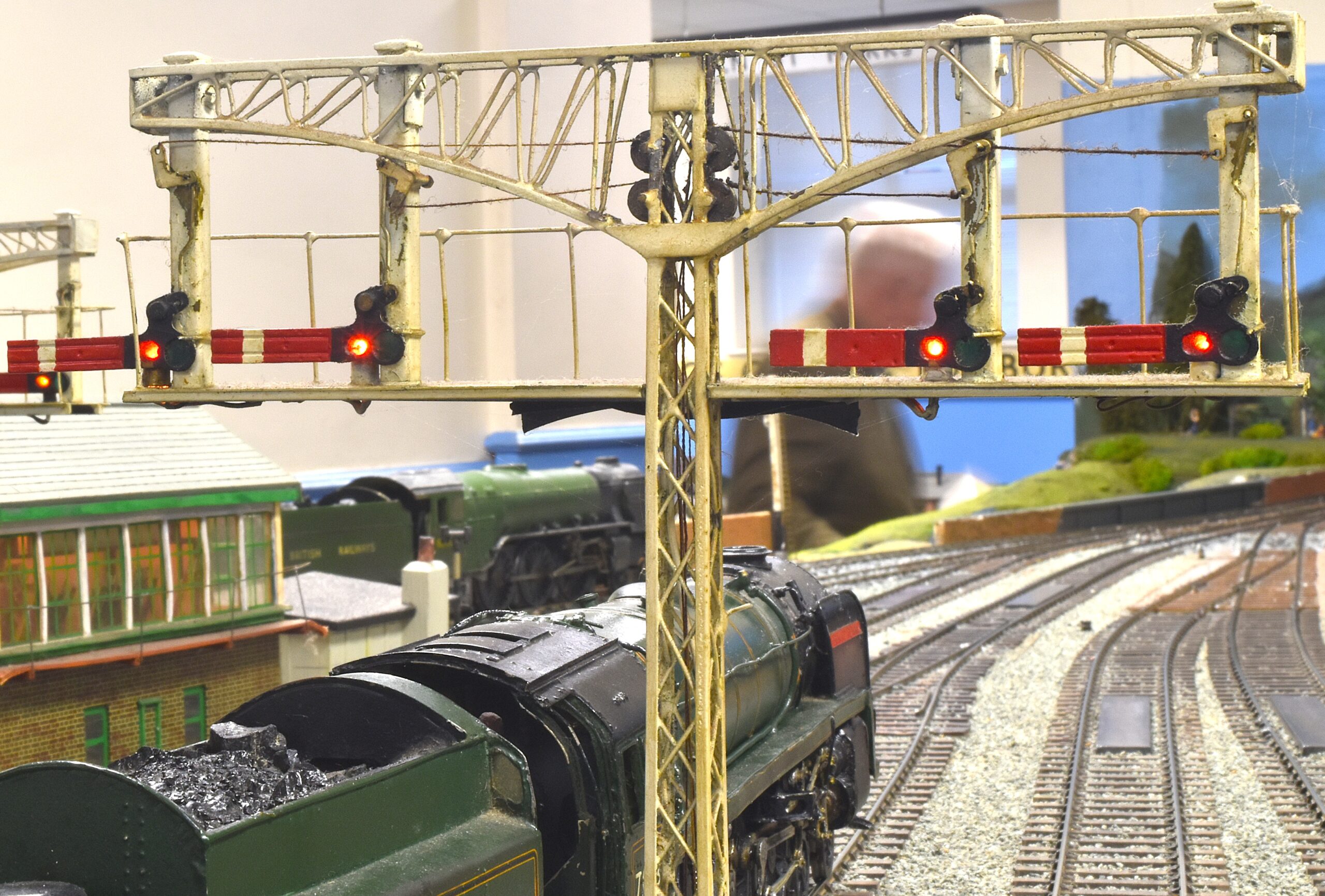
Semaphore signals rely on coloured arms that are raised or lowered to indicate that it is safe to proceed. These semaphore signals can be a variation of just a single arm, or multiple arms, where there is more than one route, with each arm identifying the route that the train will take.
Examples of semaphore signals can be seen in Hitchin, Retford and Leeds.


Colour light signals usually resemble road traffic lights (but the colours are the opposite way round with green at the top) and can have two, three or four aspects (lights) depending on their position. On the fast lines the colour light signals have four aspects, which means that they give an indication of the position of the next two signals in advance allowing trains to travel at faster speeds. On the slow lines the signals are of the three aspect configuration, meaning that they only give an indication of the next signal in advance. Two aspect signals are mainly used on the exit from the sidings to a main line. Colour light signals can be found between Kings Cross and Werrington Junction.

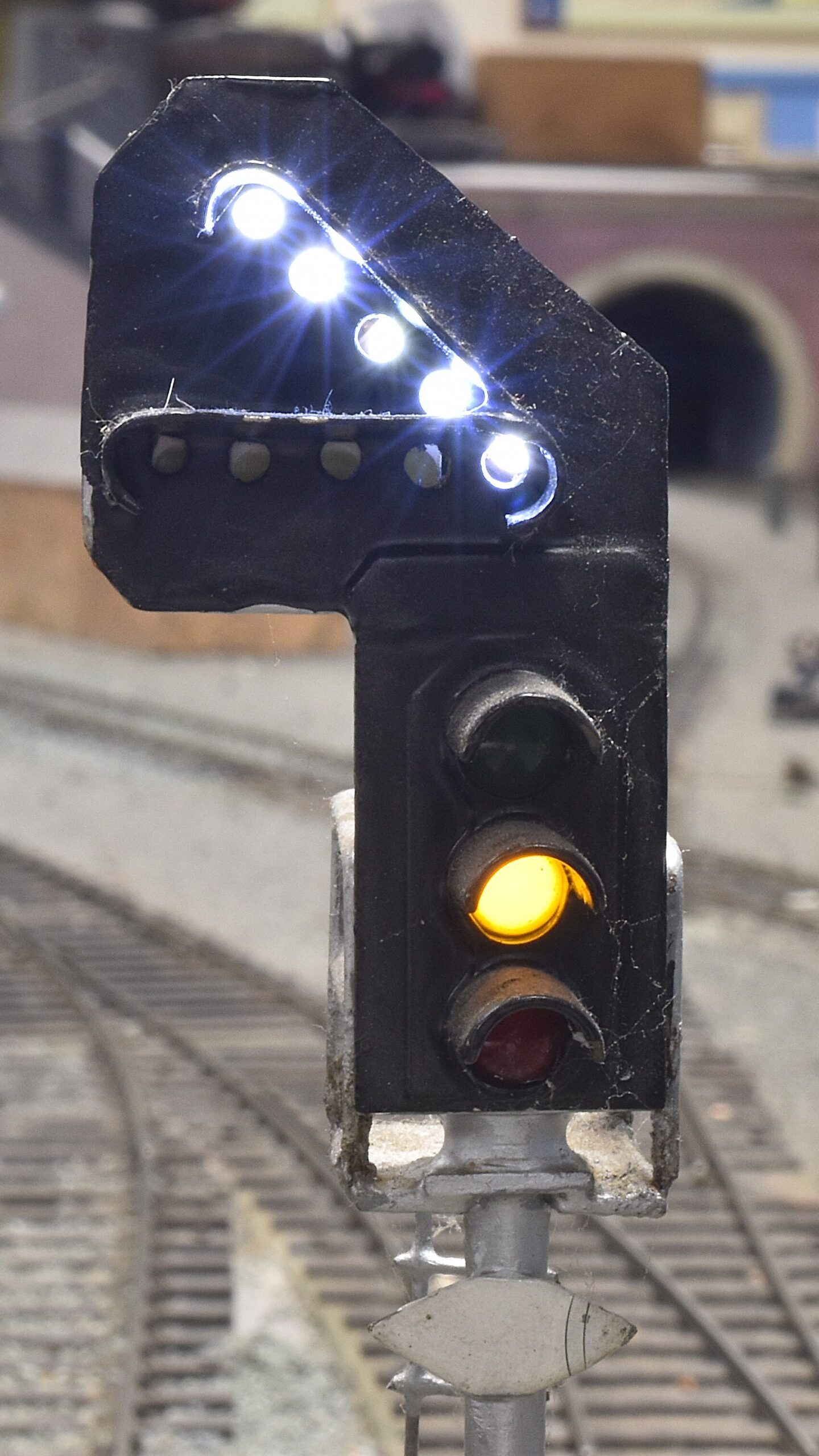
Additionally, some colour light signals also have a route indicator, or theatre indicator to provide information to the driver of the route that has been set. These consist of diagonal rows of up to five white lights positioned above the main signal. A row tilting to the left indicates a diverging route to the left, while a row tilting to the right indicates a diverging route to the right. Up to six routes can be indicated. If no feathers are lit, the train is proceeding straight ahead.
A theatre indicator uses a different method to indicate the route set. It uses letters and numbers (such as platform numbers) to inform the driver which route is set. Doncaster’s down home signal is an example.
The colour light signals in Doncaster are slightly different in that there are only one or two lights on them. Called searchlight signals, these were developed by the LNER in 1930’s, with one light being capable of showing three aspects (red, amber, green) and two lights being capable of showing four different aspects (red, amber, double amber and green).
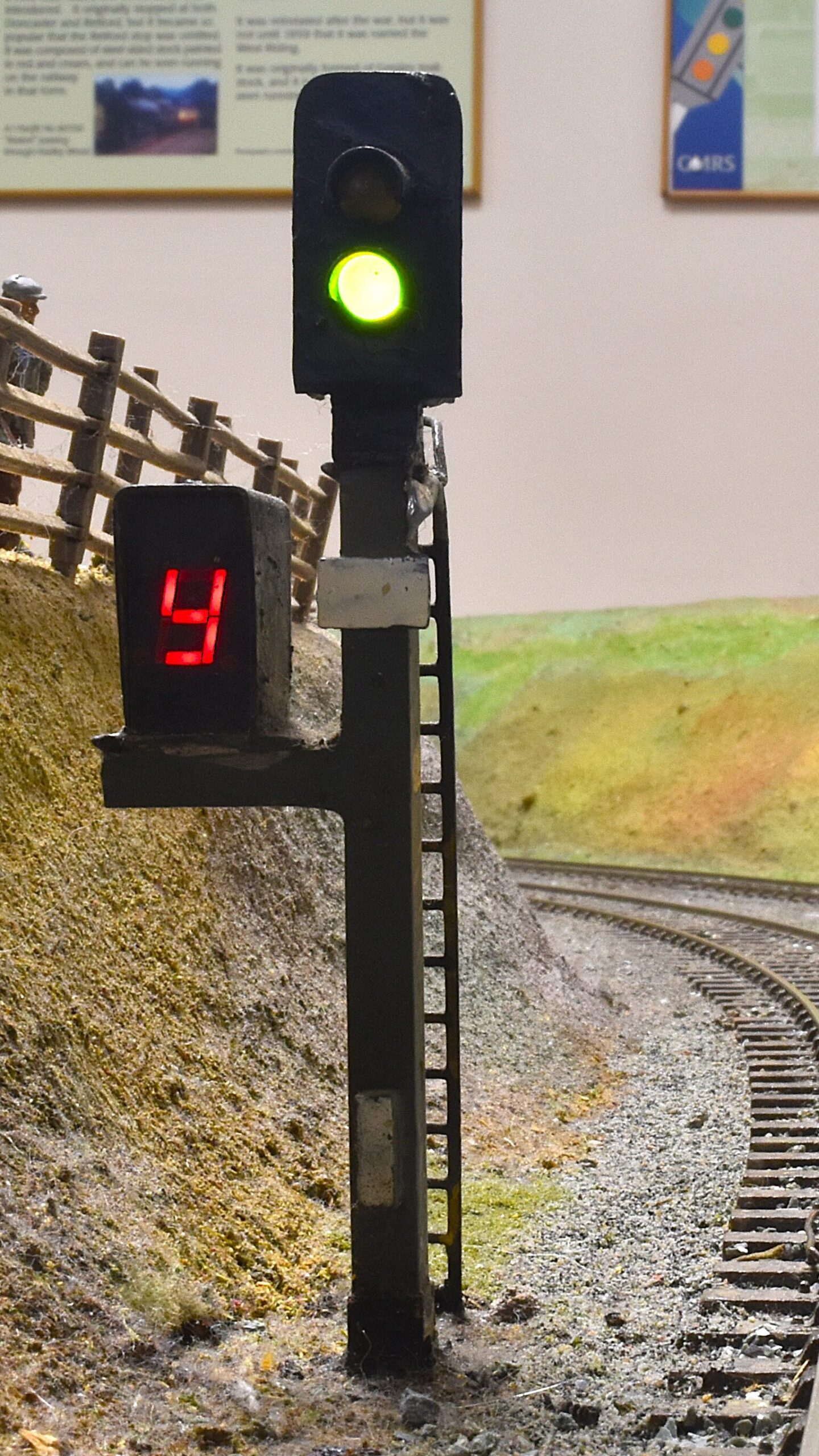
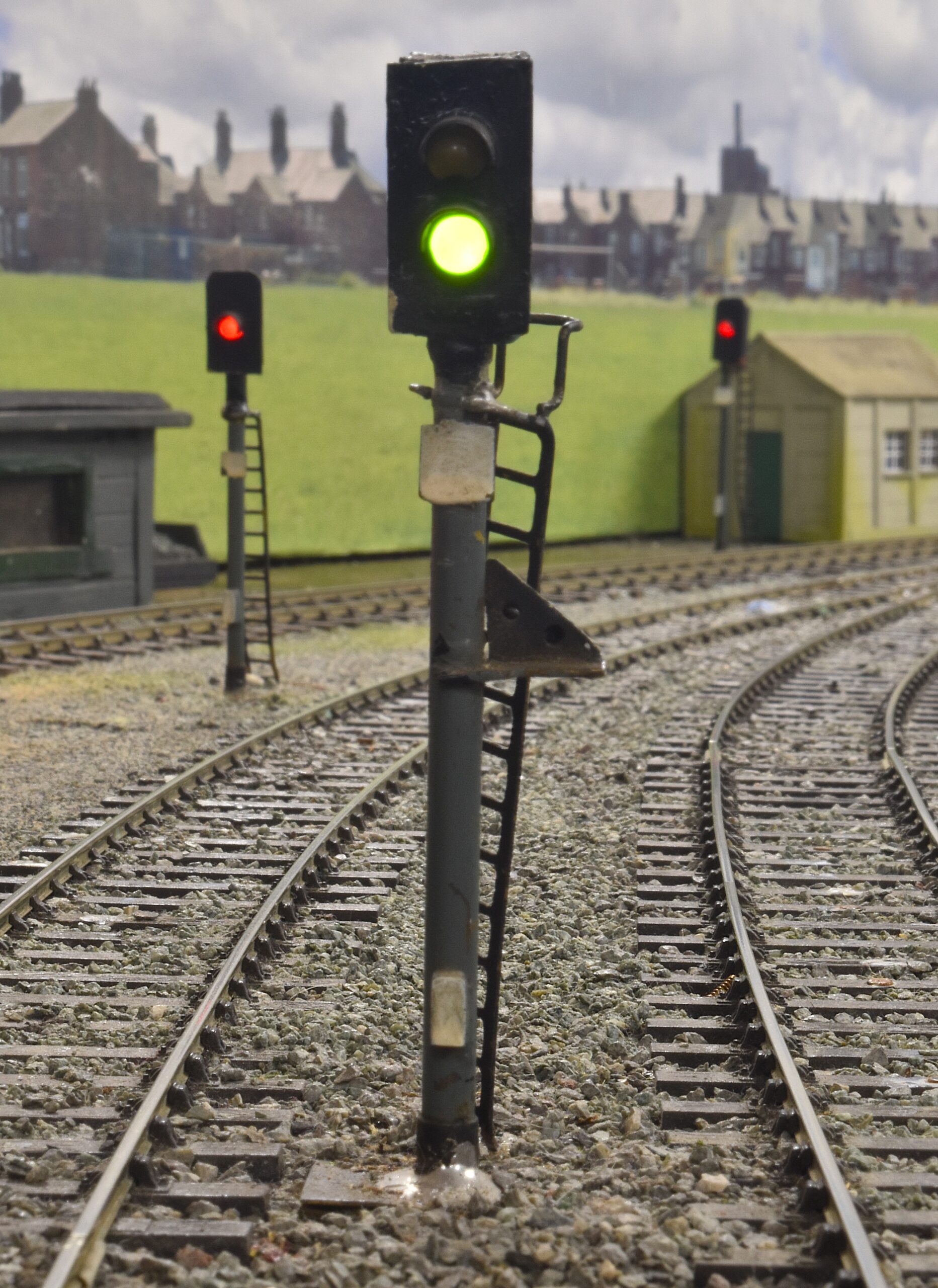
The signals are fully interlocked with the pointwork. This means that a signal can only be ‘cleared’ to allow a train to proceed if the route it relates to is set properly. If not, the signal will remain at danger. This type of failsafe system is the same as that used on the real railway. Our system uses relays (recovered from defunct Post Office telecoms panels) to ensure that power is only supplied to the motor operating the signal if the route is correctly set.
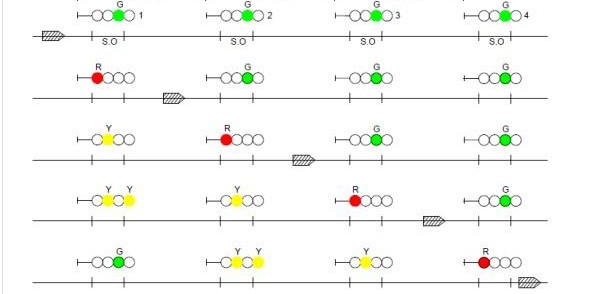
A recent improvement to the signalling between Retford and Hichin has seen the introduction of track circuits on the Werrington loop, that make the signals in this area operate semi-automatically. Mimicking the real railway, once a train passes a signal, the signal will automatically return to danger (in the diagram below this is signal 1). As the train passes the next signal (signal 2), this will also change to red and the first signal (signal 1) will now show amber. As the train proceeds past the next signal (signal 3) it will change to red, signal 2 will change to amber and signal 1 to double amber. Finally, once the train has passed signal 4, it will change to red, signal 3 to amber, signal 2 to double amber and signal 1 will once again show a green aspect, all without the signalman having to intervene.
The operators at both Werrington Junction and Hitchin also have a visual indication of where on the loop each train is. This is useful visual aide as for most of the time the operators cannot see trains on the loop.